Is Testosterone Therapy Safe? A Doctor Explains the FDA's 2026 Label Changes
By Manuel Carrazana, MD, FACP, DABOM — Board-certified in Obesity Medicine and Internal Medicine
For more than a decade, testosterone therapy labels carried warnings that made many men, and many doctors, nervous. That is changing. The FDA removed its cardiovascular boxed warning language in 2025, and in June 2026 it asked manufacturers to make three more updates. Here's what changed, what the evidence actually shows, and what hasn't changed at all.
What did the FDA change about testosterone therapy?
The updates came in two rounds.
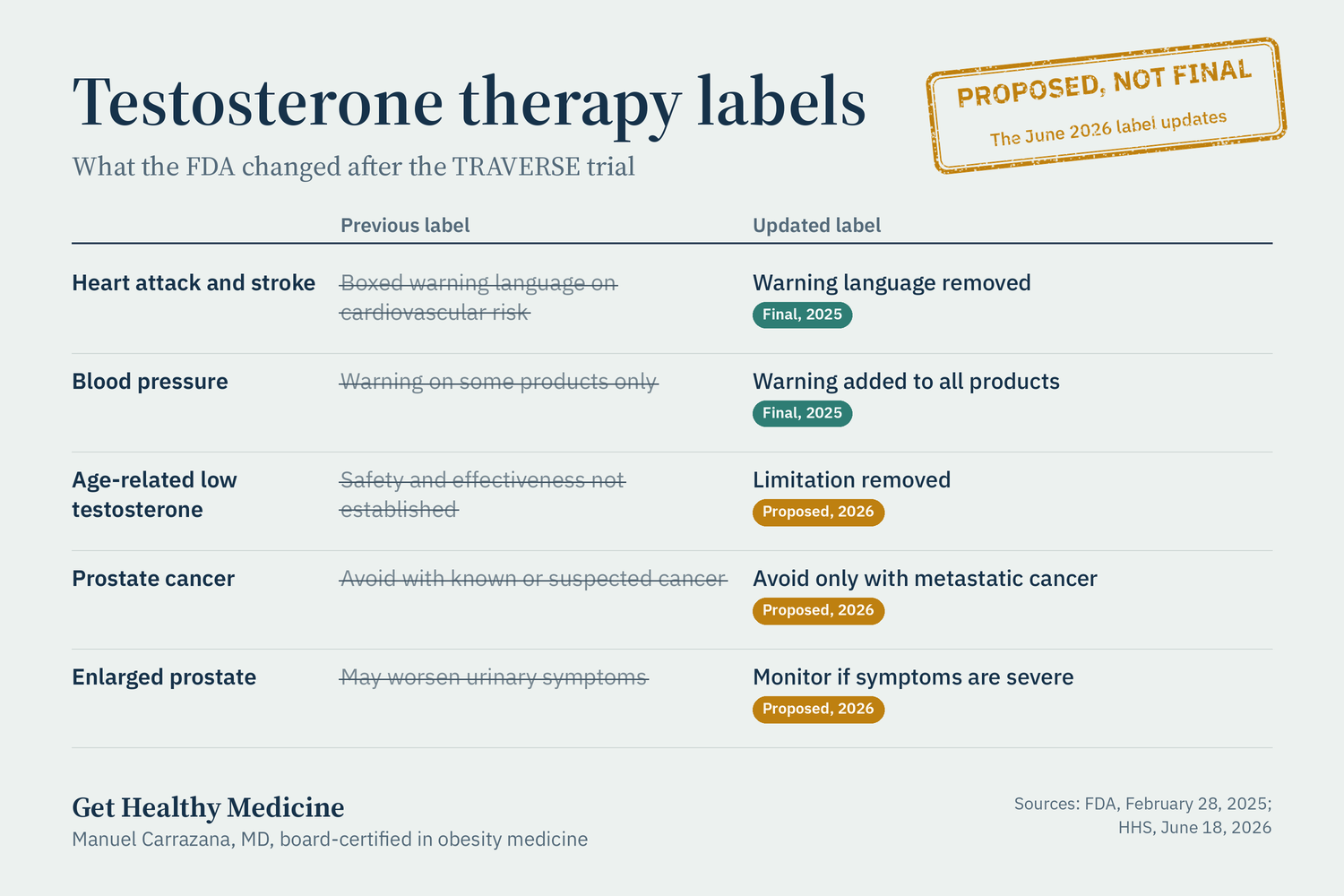
Final in 2025: After reviewing the TRAVERSE trial, the FDA removed boxed warning language about increased heart attack and stroke risk from all testosterone products. At the same time, it added a blood pressure warning to products that didn't already have one, based on studies using 24-hour blood pressure monitoring.
Proposed in June 2026: HHS and the FDA requested three further updates:
Remove the statement that testosterone's safety and effectiveness in men with age-related low testosterone "have not been established"
Narrow the prostate cancer contraindication so testosterone is off-limits only for men with metastatic prostate cancer
Revise the enlarged prostate (BPH) warning, since trials haven't shown worsening symptoms in men with mild to moderate BPH
Are the 2026 changes final?
Not yet. The June 2026 changes are requested updates, and manufacturers need to revise their prescribing information. Until that happens, labels may still show the older language. Testosterone also remains a Schedule III controlled substance, which affects how it's prescribed and refilled.
Does testosterone therapy raise heart attack or stroke risk?
The best evidence we have says no, for properly diagnosed men. TRAVERSE enrolled 5,246 men aged 45 to 80 with low testosterone and either existing heart disease or high cardiovascular risk. Major cardiovascular events occurred in 7.0% of men on testosterone versus 7.3% on placebo.
That's reassuring, but it isn't the whole story. The same trial found higher rates of:
Atrial fibrillation: 3.5% vs. 2.4%
Acute kidney injury: 2.3% vs. 1.5%
Pulmonary embolism (blood clot in the lungs): 0.9% vs. 0.5%
Add the new blood pressure warning, and the honest summary is this: testosterone doesn't appear to raise heart attack or stroke risk, but it does require real monitoring.
Does testosterone cause prostate cancer?
In TRAVERSE, high-grade prostate cancer was diagnosed in 0.19% of men on testosterone and 0.12% on placebo over about 33 months. That was 5 men versus 3, a difference that was not statistically significant.
Two important caveats. First, the trial excluded men with a PSA above 3 ng/mL or other signs of higher prostate cancer risk. Second, the numbers were small, and prostate cancer can take years to develop. HHS itself notes that important uncertainties remain. That's why the proposed labels still call for risk assessment, screening before treatment, and monitoring during therapy.
Can I take testosterone if I have an enlarged prostate?
For many men, yes. The FDA's review found that clinical trials did not show worsening urinary symptoms in men with mild to moderate BPH. Evidence is more limited for men with severe symptoms, so the proposed labels recommend closer monitoring in that group.
Does this mean testosterone is approved for aging?
This is the change I expect patients to misunderstand most. Removing the "age-related" limitation means a man's age alone is no longer a labeling barrier. It does not mean every man whose testosterone has drifted down with age should start treatment.
A diagnosis still requires both symptoms (like low sex drive, fatigue, erectile changes, or low mood) and lab confirmation. The American Urological Association recommends a total testosterone below 300 ng/dL on two separate early-morning blood tests before diagnosing low testosterone.
What hasn't changed?
Fertility: Testosterone suppresses sperm production. Men who are actively trying to conceive should not take it.
Blood counts: Testosterone can raise hematocrit (thicken the blood), so it needs to be checked before and during treatment.
Blood pressure and PSA: Both still need regular monitoring, including PSA testing before treatment in men over 40.
The right diagnosis: Symptoms plus confirmed low levels, not a single borderline result.
What does this mean if I'm considering TRT?
In my practice, these updates make conversations more accurate, not less careful. We confirm the diagnosis with repeat morning labs, talk through fertility plans, and check blood counts, PSA, and blood pressure before starting. For men with obesity, we also look at weight, because excess body fat is a common cause of lower testosterone, and treating it can be part of the solution.
The label changes remove outdated barriers. They don't remove the need for good medicine.
This article is for educational purposes only and is not a substitute for personalized medical advice. Testosterone therapy isn't right for everyone, and individual results and risks vary. Talk with your physician before starting or changing any medication.
Wondering whether low testosterone could explain how you feel? I'll review your symptoms, labs, and goals, then help you decide whether testosterone therapy makes sense for you and how to do it safely.
Get Healthy Medicine — Lake Nona / Florida telemedicine