Retatrutide: A Doctor's Honest Guide to the Newest Weight Loss Drug (and Why Not to Buy It Online)
By Manuel Carrazana, MD, FACP, DABOM — Board-certified in Obesity Medicine and Internal Medicine
Retatrutide is one of the medications patients ask me about most right now, and it's one you can't legally get. In clinical trials, this weekly injection from Eli Lilly produced the largest average weight loss we've seen from an obesity medication. It is also being sold online as a "research peptide" by vendors the FDA is now pursuing. Here's what the data actually show, when it might be approved, and what I tell my patients to do in the meantime.
What is retatrutide?
Retatrutide is an investigational, once-weekly injection being developed by Eli Lilly. It's a single molecule that activates three hormone receptors: GIP, GLP-1, and glucagon. That's why you'll hear it called a "triple agonist."
For comparison, semaglutide (Wegovy) acts on GLP-1 alone, and tirzepatide (Zepbound) acts on GLP-1 and GIP. The glucagon component is what's new. It's thought to increase energy expenditure and help the body burn stored fat, including liver fat, although exactly how much it adds in humans is still being studied.
How much weight did people lose in the trials?
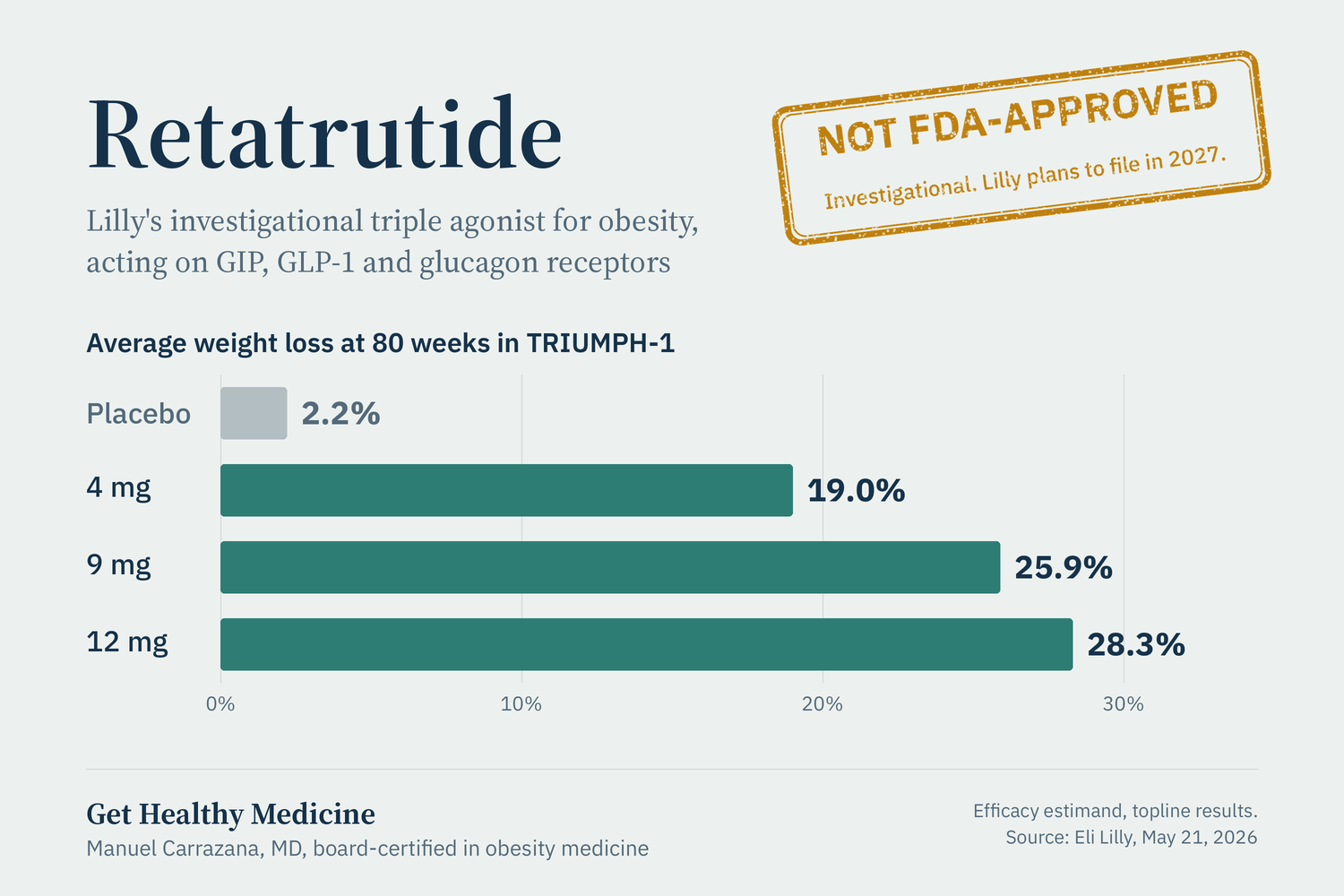
The pivotal trial, TRIUMPH-1, enrolled 2,339 adults with obesity (or overweight plus at least one weight-related condition) who did not have diabetes. Participants started at an average of about 248 lbs. After 80 weeks, average weight loss was:
19.0% on 4 mg
25.9% on 9 mg
28.3% on 12 mg (about 70 lbs)
2.2% on placebo
On the 12 mg dose, 45.3% of participants lost at least 30% of their body weight, a range historically associated with bariatric surgery. In an extension for people starting with a BMI of 35 or higher, weight loss reached 30.3% at 104 weeks.
Results were also positive in harder-to-treat groups. In TRIUMPH-2 (adults with type 2 diabetes), weight loss reached 20.8%. In TRIUMPH-3 (severe obesity plus established heart disease), it reached 22.6%.
One important detail: these headline numbers assume everyone stayed on the medication. When everyone who started is counted, including people who stopped, TRIUMPH-1's 12 mg result was 25.0%. That's still remarkable, but it's the more realistic number.
How does retatrutide compare with Wegovy and Zepbound?
No completed trial has tested retatrutide directly against these medications, so any comparison crosses different studies, populations, and trial lengths. With that caveat, using the same conservative "everyone counted" method:
Wegovy (semaglutide 2.4 mg), STEP 1: about 14.9% at 68 weeks
Zepbound (tirzepatide 15 mg), SURMOUNT-1: about 20.9% at 72 weeks
Retatrutide 12 mg, TRIUMPH-1: about 25.0% at 80 weeks
The takeaway: medications available today already produce weight loss that was unthinkable a decade ago. Retatrutide may push that further, especially for severe obesity.
What are the side effects of retatrutide?
The side effects look similar to other incretin medications, but more frequent at higher doses. In TRIUMPH-1 on 12 mg, the most common were:
Nausea: 42.4% (vs. 14.8% on placebo)
Diarrhea: 32.0% (vs. 13.5%)
Constipation: 26.1% (vs. 10.9%)
Vomiting: 25.3% (vs. 4.8%)
One newer side effect to know about is dysesthesia, meaning unusual skin sensations such as tingling, burning, or sensitivity to touch. It occurred in 12.5% of people on 12 mg in TRIUMPH-1 (vs. 0.9% on placebo) and in up to 20.9% at the highest dose in the knee osteoarthritis trial (TRIUMPH-4). Most cases were mild to moderate and resolved during treatment. Overall, 11.3% of people on 12 mg stopped because of side effects, compared with 4.9% on placebo.
Does retatrutide lower heart attack and stroke risk?
We don't know yet. In TRIUMPH-3, retatrutide improved major risk factors: triglycerides fell 37%, systolic blood pressure dropped 9.3 mmHg, and a key inflammation marker (hsCRP) fell 51%. But there were fewer heart events than expected in the trial, and the results on actual heart attacks and strokes were inconclusive. A dedicated cardiovascular outcomes trial is ongoing. Until those results are in, it's fair to say retatrutide improves heart risk factors, not that it prevents heart events.
When will retatrutide be FDA-approved?
Lilly has announced it plans to submit retatrutide to the FDA in the first quarter of 2027, based on five positive Phase 3 trials. FDA reviews typically take about 10 to 12 months after a submission is accepted, or less with a priority review. Realistically, that points to an approval decision in late 2027 at the earliest, and more likely 2028. Approval is never guaranteed, and the final label will define exactly who qualifies.
Can I buy retatrutide online or get it from a med spa?
No, not legally. Outside of Lilly's clinical trials, there is no legitimate source of retatrutide for human use. Anything sold today as retatrutide, "reta," "r3ta," or "triple G" is unapproved.
This is a real and growing problem. The FDA has sent warning letters to online sellers marketing retatrutide labeled "for research use only" while clearly selling it for people to inject. In August 2026, Lilly filed six lawsuits against med spas, a compounding pharmacy, and other vendors it says are fueling a black market for counterfeit retatrutide.
Here's why I strongly advise against these products:
You don't know what's in the vial. A "research use only" label is not a quality standard. There's no guarantee of the right drug, the right amount, or sterility.
Dosing mistakes are easy. Mixing powder and measuring small doses at home leaves plenty of room for error.
No one is monitoring you. Side effects like severe vomiting, dehydration, or gallbladder problems need medical attention, and it's harder to treat you safely if no one knows what you actually took.
Will a compounded version come later? That depends partly on an ongoing dispute over whether retatrutide is classified as a biologic, which would generally block compounding. For now, no legitimate pharmacy can provide it.
What should I do while I wait?
You don't need to wait for retatrutide to get effective treatment. FDA-approved options available now include Zepbound, Wegovy, the higher-dose Wegovy HD (7.2 mg) for people who have plateaued on 2.4 mg, and oral options like the Wegovy pill and Foundayo. For most of my patients, one of these, combined with good nutrition, strength training, and protein intake to protect muscle, gets them to a meaningful, healthy result.
If you're interested in retatrutide specifically, you can search ClinicalTrials.gov for studies that may still be enrolling.
And if you've already used a gray-market product, please tell your doctor. There's no judgment in my office. We simply want to know so we can check your health and move you to a safe, approved medication.
This article is for educational purposes only and is not a substitute for personalized medical advice. Retatrutide is investigational and not FDA-approved. Trial results reflect averages, and individual results vary. Talk with your physician before starting or changing any medication.
Wondering which weight loss medication is right for you? As a board-certified obesity medicine physician, I'll review your health history, goals, and insurance or cash-pay options, then build a plan around FDA-approved treatment that fits your life.
Get Healthy Medicine — Lake Nona / Florida telemedicine